MY WALKER FAMILY
By Fred Coffey
DEAR READER: If
you’re looking at an “.HTM” version of this report, be aware there is a “.PDF”
version with better format control and better printing capability. See:
http://www.coffey.ws/FamilyTree/FamilyNotes/AboutRobertWalkerEsq.pdf
This paper is mostly about
Robert Walker, Esquire, my oldest known Walker ancestor. First, a quick
introduction to my ancestry:
MY FAMILY LINE:
Robert WALKER Esq. (Abt 1717/20 -
bef Aug 1786) & (Unknown? Ann??)
Robert WALKER Jr. (1 Sep 1748 - ) & Mary JONES (1 Nov 1758 - 9 Jun
1853)
William WALKER* (27 Mar 1790 - Jun
1855) & Catharine KIMBREL (abt 1790 - 13 Aug 1835)
Bartlett Yancy WALKER (Oct 1819 -
aft 1906) & Frances Nixon MAXEY (7 Apr 1827 - 19 Apr 1891)
Cyrus WALKER (7 Jan 1847 - Sep
1926) & Laura Etta MYERS (4 Jul 1853 - 28 May 1902)
Everett Elmer WALKER (6 Feb
1882 - 1948) & Linnie Ellen MACHLAN (30 Sep 1884 - 7 May 1974)
Elsie Maureen WALKER
(20 Nov 1903 - 12 Mar 1983) & Leo Newton COFFEY (1901 - 1998)
Leo Frederick
Coffey (That's me!)
ADDITIONAL SOURCES:
Over time, I’ve developed
and written about several topics that are related to Robert, but are too much
to fully cover in this single document. Most of these have reference elsewhere
in this report, but are listed here for “quick reference”:
There is a DNA study,
http://www.coffey.ws/FamilyTree/FamilyNotes/WalkerDNA2.pdf
And the DNA Study stirred up
some questions about Robert’s brother David:
www.coffey.ws/FamilyTree/FamilyNotes/WalkerDNA2Appendix.pdf
Which in turn stirred up discussion
of a multitude of confusing descendants named “David”:
http://www.coffey.ws/FamilyTree/FamilyNotes/Walker7Davids.pdf
This next item is a
hodge-podge of stuff, which includes full details on Surry court notes, etc
http://www.coffey.ws/familytree/familynotes/A3WalkerCoffeyConnections.htm
There is a paper about a
“Coffey” relative that lived in Surry, that offers Surry background:
http://www.coffey.ws/FamilyTree/FamilyNotes/JamesCoffee.pdf
And there are two articles
about Robert’s relationships with the Moravians:
www.coffey.ws/FamilyTree/FamilyNotes/RobWalkerAndTheMoravians.pdf
www.coffey.ws/FamilyTree/FamilyNotes/MoravianRoads.pdf
And after Robert is gone, I
wrote about his wife Mary, son Robert, and grandson William.
www.coffey.ws/familytree/familynotes/MaryWifeOfRobert.pdf
http://www.coffey.ws/FamilyTree/Docs/WALKERRobertJr(W).pdf
http://www.coffey.ws/FamilyTree/Docs/WALKERWilliam(W).pdf
ROBERT WALKER ESQUIRE:
We’re ready to discuss
Robert Walker, Esq. But first, let me give credit where it is due: I have had a
lot of correspondence with another researcher, Randy Walker. I also owe a debt
to Craig and Kathy Walker, who are also researching Walker roots. You will read
more about them in a separate paper on this Robert's son, Robert Walker Jr. And
I have also exchanged a large volume of notes with researcher Betty Hicks.
Robert Walker is the
patriarch of my own family line. And as a quick introduction, this is a tabulation
of his marriages and children.
ROBERT'S MARRIAGES AND CHILDREN:
Robert WALKER Esq. (Abt
1717/20 - bef Aug 1786) & (Ann??)
Robert WALKER Jr. (1 Sep 1748 - ) &
Mary JONES (1 Nov 1758 - 9 Jun 1853)
William WALKER (1750 - Aug 1814)
John WALKER
David WALKER (a minor in 1786, per Robert’s
will)
James WALKER (a minor in 1786, per Robert’s
will)
Elizabeth (married Miller)
Mary WALKER (married Thomas Sylvanus “Silley”
Wright)
Hannah WALKER
Robert WALKER Esq. (Abt 1717/20
- bef Aug 1786) & Mary
Polly WALKER
Elizabeth “Betsey” WALKER (12 Dec 1785 - 24
Mar 1859) & Benjamin Franklin HOWARD Jr.
THE BIG PICTURE: ORIGINS AND EARLY LIFE:
A big contributor to our
understanding of the origins and early life of Robert has been greatly aided by
a DNA study of 14 men, who show a solid genetic connection to Robert. These 14
“cousins” proved to be a diverse group, with a variety of origins, and all were
willing to share information and sources. A working paper, with full details of
our analysis, can be found here:
http://www.coffey.ws/FamilyTree/FamilyNotes/WalkerDNA2.pdf
Some of the tested group’s
ancestors were relatively recent immigrants to America, who knew full well
their national origins. Based on this, we now have full confidence that the
original origin of our Walker family was Scotland.
However we also know that at
least one line came to America by way of Northern Ireland. Many Scots were
invited to settle in Northern Ireland in the 17th century, on
confiscated Irish lands. They are sometimes called “Ulster Scots”, or “Scots
Irish”. And, particularly given when and where Robert first entered America, it
is highly likely that he was also “Scots Irish”.
We believe that Robert, and
a brother David, first came to Pennsylvania, probably in the early or mid
1700’s. We believe they were in Pennsylvania until after 1765, because a
descendant “David” born in 1765 survived until after 1850, and he reported in
the 1850 census that he was born in Pennsylvania. THIS David was apparently a
descendant of Robert’s brother David. And it is evidence the family was in
Pennsylvania no later than 1765.
Before the American
Revolution some 200,000 people emigrated from Ulster to America, with the
largest numbers going to Pennsylvania. From there, many went South into
Virginia and the Carolinas, with Robert and brother David likely among them.
Robert was closely associated with the Moravians in North Carolina, and they
also came from Pennsylvania and pioneered the roads. Robert strategically
placed his Tavern on one of the Moravian routes, and his location was even
marked on a Moravian map! He may have even travelled with the Moravians?
At several points in this
report, we will reference Robert’s relations with the Moravians. If I say
something below that doesn’t make sense, you might want to come back and examine
the following:
www.coffey.ws/FamilyTree/FamilyNotes/RobWalkerAndTheMoravians.pdf
www.coffey.ws/FamilyTree/FamilyNotes/MoravianRoads.pdf
We will shortly introduce
evidence that Robert was in North Carolina by 1768. So most likely he made the
move south between 1765 and 1768.
ROBERT’S BROTHER, ROBERT’S WIFE:
Robert’s brother David died
in Surry County, North Carolina in about 1775, leaving orphan children David,
Lillias (Lillian?) and Hannah. There are several records in the Surry Will
Abstracts involving Robert Walker and an “Ann Walker” settling the estate of
David, and arranging guardianships for the orphan children.
Given the context, it is not
obvious whether “Ann Walker” is Robert’s wife, or David’s widow. I personally
think “Ann” is Robert’s first wife, based on limited supporting evidence:
There is a Scottish naming
convention, which proposes that the first daughter in a family should be
named after its maternal grandmother, the second daughter should be
named after its paternal grandmother, and the third daughter should be
named after its mother.
When we look at the family
of Robert Walker Jr. (the son of Robert Walker Esq.) we find his first
daughter is named Jamina, and we know that was the name of her maternal
grandmother. The third daughter was named Mary, and that was the name of
her mother. Sounds like Robert Jr. was following the convention!
And Robert Junior’s second
daughter, who should therefore have been named after her paternal grandmother
(the wife of Robert Sr.)? That was "Anne". It fits really well!
For the record, here are the
relevant abstract references:
Surry Will Abstracts: 1:46. Inv. of
sale of David Walker decd. Buyers were: Ann
Walker, David Walker, Robert Walker, Charles McCay, Jacob John Scott,
Jacob Myers, John Holey, George Hyet, Andrew Lowery, Robert Walker Sr., Peter Ludwick, John Growse, Martin
Armstrong, Robert Lanier, Jo. Williams, Peter Shermer, Traugott Bagge, John
Healey, etc. Total retnd to May Ct. 1775 by Ann Walker & Robert Walker admins. L44:12: 6.
Surry Will Abstracts: 1:93a. Ann Walker, William Dobson,
Richard Goode, Joseph Winston are bound to Martin Armstrong, Robert Lanier,
John Hudspeth, Matthew Brooks, Justices, for L500 N.C. money 12 Feb. 1778 as Ann Walker and William Dobson
jointly are appointed guardians of David
Walker, Lillias Walker and Hannah Walker, orphans of David Walker decd.
Wit: Jos. Williams. Rec. Feb. Ct. 1778.
Surry Will Abstracts: ”1:102. Acct.
of est. of children of David Walker decd by Ann Walker & William Dobson, guardians. 13 May 1778.
Cash reed of Robert Warwick L4, ditto Robert
Walker LI. Rec. May Ct. 1778.
Surry Will Abstracts: 1:107a. Robert Walker, William Dobson,
Martin Armstrong & Michael Howzer are bound to John Hudspeth, Charles
McAnally & Robert Lanier, Surry Co. Justices, for L200 proc 14 May 1788
(sic) as Walker &. Dobson
are bound guardians of David Walker, orphan of David Walker decd, making
exhibit to the Justices in 3 mos. of their guardianship accts. Wit: Jo.
Williams, Clk. Rec. May Ct. 1778.
But now we can move on to
information in which I do have more confidence:
COUNTIES OF NW NORTH CAROLINA:
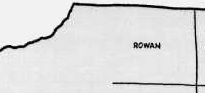 It's going to be tough to follow the history of Robert
Walker, Esq., and his family, if you don't examine the history of the area
where he lived. We're looking at the northwest part of North Carolina:
It's going to be tough to follow the history of Robert
Walker, Esq., and his family, if you don't examine the history of the area
where he lived. We're looking at the northwest part of North Carolina:
In 1753 Rowan County was
formed, and we find Robert living there by no later than 1768:
We can find several
references to Robert Walker in the Rowan Co. NC Court of Pleas & Quarter
Sessions Book #3. In these records he appears before the Court as an ordinary
citizen. He is also found in tax lists for this time period, including 1768.
The earliest reference comes
from Rowan Co. Court Records: July 16, 1768: "On motion of John Dunn, Esqr. ordered by the court that Robert
Walker have leave to keep an Ordinary at his own dwelling house in Rowan
County. Security William Tim: Cole and Thomas Stilwell." (An
"Ordinary" is a form of tavern, and we are going to find that Robert
was in the tavern business until his death, with his wife taking over
thereafter.)
This tavern could arguably
be considered the origin of the modern city of Walkertown, NC - - we'll talk
more about that later.
A major function of the
Court was to manage the roads in the county, with citizens appointed to various
duties. In January 1769, we find this appointment: "Overseer of Roads
Robert Walker from Vacouia Line to Sandy Ridge Capefare Road (from Wachovia to
Cape Fear)"
Also in August 1769 he
returns to court for a renewal: "Ordinary
License renewed for one year at his dwelling house." And again on
14 Aug 1770 "Ordered that Robert
Walker have license to keep Ordinary at his dwelling house."
Regarding these Tavern
Bonds, Craig & Kathy Walker found the following transcript of the actual
August 1769 bond. The spelling and punctuation of the original document are
preserved:
"KNOW all Men by these Presents that we Robert Walker, Wm Temple Cole & Charles McAnally are held and
firmly bound unto Wm Tryon
Governor and Commander in Chiefe in and over the Provence of North Carolina in
the Sume for Thurtey Pounds Proclamation Money to bee paid to the Governor or
his Successors to the which Payement well and truly to be made we binde
ourselves and Every of us our and every of our Heirs Executors and
Administrators jointly severally firmly by these Presents Sealed with our seals
and Dated the 9th Day of August 1769
The Condition of this Obligation is such That whereas the sd
Robert Walker hath obtained a
License to Keep A Tavron on his Plantation where he livs on the moraven Road on the Waters of muddy Creek in Rowan County if therefore ye sd Robert Walker doth Constantly find and provide in his or her
said Tavern Good wholesome and Clean Diet and Lodging for Travelers and Stable
Fodder & Corn or Pasturage as the Season Shall require for thine Horses for
and during the terme of one yeare from the 9 Day of August and shall not suffer
unlawful Gammeing in his or her House nor sell Liquer on the Lords Day to aney
Person by which such Persons may in toxicated then the Obligation to be void
Otherwise to Remaine in force
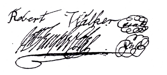 And this comes with the signatures of Robert and of Wm
Temple Cole (not sure, the second entry handwriting is incredible!):
And this comes with the signatures of Robert and of Wm
Temple Cole (not sure, the second entry handwriting is incredible!):
Oh, note that the Bond
states that Robert “ …livs on the moraven Road....”. As noted
earlier, Robert strategically placed his Tavern on a major Moravian route to
and from Pennsylvania.
There is another function of
the Court - it approves the brands that citizens may apply to their livestock.
The following would appear to prove that Robert was therefore engaged in
farming, as well as running his tavern: "Rowan Co. Court Records: 1771 Robert Walker Mark is sloping crop of
each year (ear), one on the four (fore?) side of the left year and the other
slops back side of the right year & Brand is R3 on the right
shoulder and buttocks."
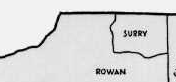
SURRY COUNTY:
 Then in 1771 Surry County was formed, and that now included
Robert's home. All of his court records henceforth refer to Surry County. The
Surry County courthouse was established in 1779 at a placed called Richmond.
(But don't look for Richmond on a NC map - - it no longer exists!)
Then in 1771 Surry County was formed, and that now included
Robert's home. All of his court records henceforth refer to Surry County. The
Surry County courthouse was established in 1779 at a placed called Richmond.
(But don't look for Richmond on a NC map - - it no longer exists!)
We're going to find a lot of
information about Robert in the Court Records for this new Surry County. We'll
come back to that shortly. But first a little more geography:
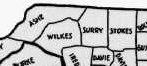
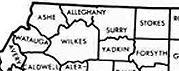 In 1789 (after Robert's death) Surry was split, and Stokes
County was formed. The old courthouse was now inconvenient, so both counties
formed new county seats, and Richmond was ultimately abandoned. Robert was dead
by then, but his old home and The Old Richmond Courthouse were now in Stokes
County.
In 1789 (after Robert's death) Surry was split, and Stokes
County was formed. The old courthouse was now inconvenient, so both counties
formed new county seats, and Richmond was ultimately abandoned. Robert was dead
by then, but his old home and The Old Richmond Courthouse were now in Stokes
County.
Then in 1849 and 1850 Surry
and Stokes counties were each split again, adding Yadkin and Forsyth counties.
And where then was the Old Richmond Courthouse? It was on the Forsyth County
side, near where the four counties come together.
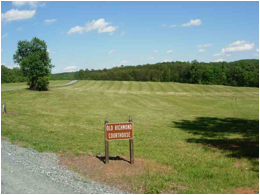
So where would we go if we
wanted to visit GGGGG Grandpa Walker's old Richmond home? The Richmond
Courthouse is now just an archeological site, located in Forsyth County, near
Tobaccoville, NC, on Payne Road just off Donnaha Road, near the Yadkin River.
That would be about 15 miles northwest of Winston Salem, NC. Here’s what it
looks like today:
TAX LISTS:
The Rowan Co Tax list shows
Robert Walker on 1768 tax list of Jacob Laesch. This list is for Bellows Creek (aka Belews Creek), The listing is
"Robert Walker & son Robert 1 poll". They have no slaves. (The
one poll tax is probably for Robert Jr., with Robert Sr. probably not required
to pay the poll tax because he is older than age 50 at that time.)
The 1771 tax list of Surry
Co. shows Robert Walker with 3 polls. The 1782 Surry tax list shows Robert
Walker with 1212 acres. The 1785 tax list of Capt. Lovill shows Robert Walker
with 1112 acres. 1 white poll, 3 black polls, on the 1786 tax listing is
"Mary Walker, Escrs of Robert Walker decd" and show 812 acres, 3
black polls and 17 town lots.
Later I'll discuss his land
ownership a bit more.
ROBERT WALKER, ESQUIRE
Two of the most fascinating
documents I have found are the Rowan and Surry County Court minutes. Most of
this comes from the abstract of "Surry County, North Carolina, Court
Minutes Volumes I and II 1768-1789" by Mrs. W. O. Absher. In this abstract,
in addition to dozens of references to Robert, we can find a number of my other
relatives. I have written a whole separate paper on Surry County and my family
connections based on these court minutes, and other references. You can examine
the full details by clicking on the following:
http://www.coffey.ws/familytree/familynotes/A3WalkerCoffeyConnections.htm
CAUTION: This is a messy and
complex site, and rambles on about many ancestors in addition to Robert Walker.
But it will allow you to examine more carefully the actual entries in the Court
minutes.
Anyway, here are some of the
highlights regarding Robert: Let me first address his title,
"Esquire". Originally, in the Middle Ages, this was a person who
ranked "above a gentleman, and below a knight". It has since evolved
in the United States to usually be a "…sign of courtesy toward members of
the legal profession". I seriously doubt that Robert was formally trained
as a lawyer, but in North Carolina in the late 1700's it would have probably
been a courtesy reference to his official duties with the court.
When we looked at the Rowan
County court records above, Robert appeared as an ordinary citizen. But in
about 1771, when the new Surry County was formed, we suddenly find him
consistently referred to as "Robert Walker Esquire", and he is found
serving as a commissioner, or justice, in the Surry County North Carolina Court
Minutes. It would appear he saw an opportunity to move up when the new county
was formed?
The first Surry County
reference is actually found in the original survey for the boundary of the new
Surry County (see above “Connections” link for the survey transcript). This is
a tedious but fascinating document, using trees, houses, creeks, water falls,
fish traps, oak saplings, etc., etc. as survey landmarks. But at one point we
find the Survey line described as "…running west crossing a branch of Dan
River East of Robert Walkers Esquire, thence East of his house about
one-quarter of a mile, crossing the easternmost Branch of Muddy Creek, thence
through the Moravian Tract, crossing the fork of the road . . " etc., etc.
This survey was filed and
proven before Jesse Benton, the clerk of Surry Court in 1771. The interesting
thing is that he is now "Robert Walker Esquire", suggesting that he
had already assumed his official court duties.
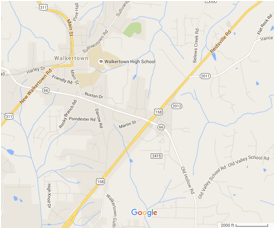 The adjacent modern map gives you a quick introduction to
the area being discussed, which is near modern Walkertown, NC. Note the blue
lines, which show the streams through the area. And take note of Hwy 66, Old
Hollow Road. This road is essentially the watershed for the area. Streams north
of this line flow north, and are branches of the Dan River. And streams south
of this line flow south, into what was then known as Muddy Creek. Also note Hwy
158, Reidsville Road. This is approximately the route of the “road to the iron
works” which was first described as passing from Robert’s house. More on all
this later.
The adjacent modern map gives you a quick introduction to
the area being discussed, which is near modern Walkertown, NC. Note the blue
lines, which show the streams through the area. And take note of Hwy 66, Old
Hollow Road. This road is essentially the watershed for the area. Streams north
of this line flow north, and are branches of the Dan River. And streams south
of this line flow south, into what was then known as Muddy Creek. Also note Hwy
158, Reidsville Road. This is approximately the route of the “road to the iron
works” which was first described as passing from Robert’s house. More on all
this later.
(Note: The above Survey suggests
his house was near the southern BORDER of the original Surry County. Be aware
that the border was later moved a few miles farther south, and also be aware
that Robert later moved to the town of Richmond, the County Seat, which was in
the center of Surry. More discussions of locations will follow. Land records
show that on 14 Feb 1779 Robert Walker bought 12 1/2 acres in the town of
Richmond for 33 pounds – he was ready to move to the new county seat as
soon as it was established.)
Found another early
reference related to the startup of Surry County, but this one was actually
located in the “Surry Will Abstracts” (even though it has no relationship to
wills): “Martin Armstrong, John Armstrong, Robt.
Walker & William Roberson of Surry are bound to his majesty for
1000 pds. sterl. as Martin Armstrong is appointed Sheriff of Surry Co. 3 Apr.
1771. Wit: Jesse Benton. Rec. May Ct. 1771,” Robert’s very good friend (see
later!) Martin Armstrong is appointed Sheriff of Surry County, with Robert
helping post bond. The new county is ready to go!
Many of the early Surry
court records are missing, with only bits and pieces available in the earliest
years. Here’s another of the earlier records: He is reported as
"Present" in the official minutes for "the third Tuesday (of)
February (in the) 11th year (of the) Reign (of) Lord George Third". Got
that?
(That date, in a system
called Regnal years, counts from the date the monarch came to the throne, and
translating it was a bit of a challenge. But after some research, and learning
that George III became King on 25 Oct 1760, I worked the date out to be
"Tuesday, February 18, 1772".)
The first Surry Court
sessions were held at the house of Gideon Wright, one of the
"Esquires". This is because the new courthouse was not yet built.
(Note: Will address locations in more detail later.) Here's the preamble to one
of this court's early rulings, naming Robert, and explaining their official
duties:
09 Nov 1771 (CR092.326.17, Surry Co., NC Criminal Action
Papers) North Carolina
Surry County
At an inferior Court of Pleas & quarter Sessions begun
and held in & for the County of Surry on the Third Sunday of November in
the twelfth year of the Reign of our Sovereign Lord George the third by the
Grace of God of Great Britain France and Ireland King Defender of the Faith
& Before the Worshipful Jacob BONN Charles MCANALLY Gideon WRIGHT and Robert WALKER Esquires and
others their Companion Justices assigned to keep the Peace for said County and
also to hear and determine all Petty Larcenies Trespasses, Assaults Batteries
Crimes and Misdemeanors of an inferior Nature Whatsoever committed or done in
the County aforesaid.
It appears that the County
Court sat about 4 times a year, for only a few days each session. Therefore
Robert still had plenty of time to tend to his lands and his tavern.
Reading the court minutes, Robert’s
name appears with great frequency. Not surprising, since he is present in his
official duties at many of the meetings.
He also appears fairly often
as the SUBJECT of court proceedings as well. For one thing he kept a Tavern at
his house, and needed to renew his license at regular intervals. Was there a
conflict of interest? Well, to his credit, he does not appear to have been
sitting as a Commissioner on any of the particular days when HIS tavern license
came up for renewal! However - - we do
find him sitting at the bench on 9 May 1785 when it is "Ordered: Tavern
Rates (shall) be amended as follows: Good cider 6 (shillings?) per quart til 1
Feb. annually; afterward at 8;…"
With regard to another
entry, we can't be sure if he was interested in the welfare of the community
orphans - or just looking for cheap servants. But on 13 May 1785 we find
"Ordered: Sarah Brandon, orphan of Wm. Brandon, deceased, age seven years,
be bound unto Robert Walker and his wife Mary, (to) learn mistery Spinster
until 18 years and at her freedom be given feather bed, furniture, cow and
calf…"
(This "learn mistery
Spinster" threw me, until I found another genealogy reference indicating
that it meant she was to learn how to be a spinster - - how to spin and do
other household duties.)
Robert apparently had other
young servants, possibly acquired the same way. But one of those, apparently a
very brave lad, had the nerve to appear before the court on 9 May 1780, and
complain: "John McCay, servant boy of Robert Walker, brought before Ct.
& complained his master had used him with too much severity, which fact
Walker acknowledged. Ordered: In future Walker shall find John McCay during his
servitude good, wholesome diet, clothing, washing and lodging and (shall) give
him unreasonable correction at no time…".
Robert did not tolerate
insolence when he sat as Commissioner. We find on 19 November 1785
"Ordered: William Crawford, Esq. Fined 5 shillings for profane swearing
and speaking in contempt of Court after he was order to Silence; fine paid and
delivered to Robert Walker, Esqr."
Apparently the court and
community were strict in other ways as well. At roughly the time the new
courthouse was ready, we find on 11 Feb 1779
"Ordered Robert WALKER, Esqr. And Samuel CUMMINS appointed
commissioners to provide and agree with workman to erect Stocks and Whiping
Post in town Richmond and call upon County Trustee for money for expense of
same." And apparently such County equipment only had a limited life,
because we later find on 12 August 1785 another entry "Ordered: Commissioners
to employ workman to erect Pair Stocks & Whipping Post at Court
House…"
But they could be generous
to those less fortunate. Quite often people were made exempt from the poll tax
for various reasons such as age or poverty. On 10 November 1779 we find
"Ordered: William McFee to be cleared from paying tax; he being object of
pity and no person to work for him."
A very frequent action of
the Court is to order citizens to serve to inspect the roads around the county.
(I believe the farm/home owner was responsible for maintaining the roads
fronting on his property, but the County needed to assure it was done
properly?) Robert often sat on the Commission that make those orders, but he
also was assigned to serve to "view a road" himself on occasion.
Robert Walker Esq., and his
son Robert Jr., both are present from time to time in the Court records. At one
point they were both appointed to the same committee to view some roads.
Sometimes, particularly after Robert Sr. dies and Jr. becomes the Sr. Robert,
you have to be careful which one you are reading about!
The Commissioners also appointed
citizens to serve on juries, and Robert Jr. was so ordered on 11 Feb 1779, and
he served for two days on 12-13 May 1779. The striking thing is that the same
single jury heard NINE civil cases over just those two days. Justice was swift!
Robert also served as the
County tax collector for a while: An entry in the Surry Will Abstracts reports
that on 17 Aug 1780 “…sd Walker is appointed Tax Commissioner”. (And an entry
in the Moravian’s Bethabera Diary on 27 Nov 1782 reports "Mr. Walker was
here to collect the grain tax, which was paid to him in Tickets and
money.")
The Court usually assembled
four times a year, in February, May, August, and November. Particularly in the
later years, Robert Walker tended to appear only on the first day of the
session and to conduct no business on that day. It is my guess that he was sort
of a "senior justice", and perhaps came in primarily to organize the
agenda for the current session? Or maybe he was getting old, and it was just an
honorary appearance?
A final note: We don't know
exactly when Robert Walker Esquire died, but his last appearance in official
capacity was on 13 February 1786. In that same session he appeared of 14
February to enter a deed of property to Mordecai Mendenhall, and swore an oath
that the deed was valid.
And then on the next day, 15
February, he appeared as a plaintiff, and then as a defendant, before a jury in
two court cases. Apparently he and another person sued each other for slander.
The same jury heard both cases, and found for the defendant in each case. (In
other words, the jury decided neither party was really guilty of slander.) And
on 18 February he was named as a member of a census committee (see "Census
Taker" below).
He appears once more in the
May 1786 session, but not in an official capacity. He and his wife Mary entered
a deed on 10 May. And he was sued by a Richard Philips on 11 May. (It is not
clear why there was a lawsuit, and is not clear what was the outcome.)
He obviously died some time
between the May and August 1786 Court Sessions.
There was a flurry of court
activity related to his death in the session that sat on 15-16 Aug 1786. The
first to appear was his wife Mary, who wanted leave to continue to keep the
Tavern operating at her home. On lesser matters, the Commissioners appointed a
replacement for Robert, and his will was proved. Over the next two years there
were several more court actions related to his estate.
CENSUS TAKER:
One of Robert's last
official acts on County business also tells us something of his family: There
was a "North Carolina Census 1784-1787". And the Court minutes of 18
Feb 1786 contain the item "Report of committee to examine lists of
Inhabitants of County as follows: LOVILLES District: Robert WALKER."
(Other committee members also named). And the actual census data report names
"A list of souls for the District of Capt. Lovel, Taken by Robert
Walker". (I would presume this was the district around Richmond, where I
believe Robert was living at the time.)
The census report lists the
first person as Robert Walker himself, with household consisting of: "1
White Male 21-60 years; 2 White Males under 21 & above 60; 4 White Females
all ages; 3 Blacks 12-50; 2 Blacks under 12 and above 50".
HIS WILL:
Craig & Kathy Walker
found a copy of Robert's will. You can view an image of the original (Caution:
it's a large file!) at:
www.coffey.ws/FamilyTree/FamilyNotes/Robert_Walker_Esq_Will.PDF
The text of his will (with added notes clarifying recipients)
follows:
"North Carolina, Surry
County, March [blank] day, the year of our Lord God 1786. I Robert Walker of the County aforesaid and
Town of Richmond do hereby in the name of God amen, constitute make and ordain
this to be my last will and testament. First of all and order that my body be
buried decently at the discretion of my executors and that all my lawful debts
and funeral charges be paid. I do hereby
will and order that my wife Mary Walker and my son Robert Walker and my trusty
friend Col Martin Armstrong to be appointed the executors of this my last will
testament.
(Mary Walker – Wife)
"I do hereby will and
bequeath unto my beloved wife, Mary Walker the third of all my moveable estate,
as also all the negros so long as she lives in widow-hood after my death, only
the negro Phillip shall be sold or hired, and Rose shall remain with her
mistress as long as the negro Rose lives.
I also will and order that my wife shall have the raising of her
children and that she raise them at the whole expense of the estate. I allow my wife any one of the plantations I
own, that she chooses, until all of the children comes of age. As also the still, the utensils of husbandry,
two horses, five cows and calves, her bed and bedding and chest of drawers, her
tea ware and kitchen furniture and all the negros till the children come of
age; but that an inventory be taken of the whole and valued and if that my
widow marrys then she shall have the thirds only and the court shall choose
guardians for the children. As also I
will to my wife her mare and saddle and the thirds of all the moneys in hand
and the thirds of all on the books. And
also three hundred acres of land on the East side of the River Tennessee.
(James – son)
"I do here give and
bequeath unto my son James five hundred acres of land on the East side of the
River Tennessee. As also three hundred
acres on Duck River out of the 180
hundred tract, and my horse and saddle, and watch, and fifty pounds in money
when he comes of age. I do also allow
that he shall be well learned in English arithmetic and astronomy and tuition
at the expense of the whole estate.
(David – son)
"I also will and
bequeath unto my son David three hundred acres of land on Duck River of the
aforesaid tract. As also five hundred
acres on the West side of the Tennessee River and also five hundred acres on
the East side of the Tennessee River and their heirs forever, to have and to
hold. As also to David I will & ordain that he shall have when he shall be
of age a horse & saddle of the value of twenty five pounds and five pounds
for to buy him a watch, my buckles and hat and that my apparel and books be
divided at the discretion of my wife and the David shall have learning equally
as high as James. As also I will and order that David shall have a negro bought
equally good value to Peter if there be not any in my possession at my
death.
(Polly & Betsey – young daughters by last (meaning
current) wife)
"I do further will and
bequeath to my daughter Polly, had by the last wife, the negro child named
Susey. As also twenty five pounds in money when she is of age, as also a horse
and saddle valued to twenty five pounds, a cow & calf, a bed & bedding,
and chest of drawers. And to my daughter
Betsey, by the last wife, I give and bequeath the negro child Mann, and a horse
and saddle, a cow and calf, a bed and bedding, a chest of drawers and twenty
five pounds in money and good learning to both and if ___ both of them marrys
contrary to their mothers will & consent they shall forfeit the one half of
their portion and their mother or their guardian shall dispose of it to any of
their brethren as seems good to them.
(Robert Walker – son)
"I do hereby will and
bequeath unto my son Robert Walker three hundred acres of land on Duck River
out of the 180 acres tract and five shillings in money to him and his heirs to
have & to hold forever.
(Robert Walker – grandson, son of Robert Walker)
"As also to his son
Robert Walker I give & bequeath three hundred acres out of the aforesaid
track to him & his heirs forever.
As also fifty pounds in money to be wholly expended on him in learning
from time to time as need requires.
(Robert Walker – grandson, son of William Walker)
"As also I give &
bequeath unto Robert Walker, the son of my son William Walker, to him I give
and bequeath three hundred acres of land on the West side of the Tennessee
River as also twenty five pounds in money to be expended on him in learning as
his need requires, the said lands to have and to hold forever, him, and his
heirs.
(Possible Future – grandson, son of John Walker)
"As also I do hereby
give & bequeath unto a son of my son John Walker if so be that he has a son
called Robert Walker to him I give and bequeath two hundred acres of land on
the West side of the Tennessee.
(Robert Wright – grandson, son of Silley Wright &
Mary Walker Wright)
"As also I give &
bequeath onto Robert Wright, my grand son, son of Silley Wright to him I give
and bequeath two hundred acres of land on the East side of the Tennessee, to
have and to hold forever and his heirs.
(Mary Miller – granddaughter - daughter of Elizabeth
(Betsey) Miller)
"As also I will and
bequeath unto Mary Miller the daughter of Betsey Miller two hundred acres of
land on the West side of the Tennessee to have and her ____ being forever to
have and hold.
(William Walker – son)
"I do hereby will &
bequeath unto my son William Walker five shillings.
(John Walker – son)
As also unto my son John
Walker I will and bequeath five shillings.
(Elizabeth Miller & Mary
Wright- daughters)
"And to my daughter
Elizabeth Miller and also unto Mary Wright my daughter I will and bequeath to
each of them five shillings and asset of meaning in value equal to three pounds
to each of them.
(Mary Walker – no relationship noted – his
wife?)
"As also to Mary
Walker, I give and bequeath five shillings and asset of meaning equal value as
aforesaid.
(Hannah Walker – no relationship noted)
"And to Hannah Walker I
give and bequeath five shillings in money and asset of meaning equal value as
aforesaid.
(Polly & Betsey – young daughters by last (meaning
current) wife)
"I further do will
& bequeath unto my two young daughters Polly and Betsey by the last wife to
them I give and bequeath to each of them three hundred acres of land on the
East side of the Tennessee River next to their mothers land to them and their
heirs forever.
(Future Children)
"NB_____ if any more
children shall hereafter be born to me by my wife, they shall have and enjoy
equal portion with those now mentioned of the last wife’s children, if the
estate can bear it, if not they must have a dividend out of the aforesaid
bequeath with their brothers and sisters.
(Closing)
"And all the _________
after all the bequeaths ___ ___ off
shall be sold at publick sale as also all the lands, ____, and _____________
except what is bequeathed and five years until given, and paid in equal ___
giving __________and paying interest.
NB___I allow it is best, I
will that Peter the negro shall remain with my widow as long as she lives a
widow and a young boy be bought out of the estate for James, the same he shall
have and hold forever.
And after their mothers
death the sons shall have double portions with the girls and so all the negros
that ___ is then and after shall be
property divided among her children.
I do hereby revoke disannul
all other former wills and acknowledge this to be my last will and testament
before these presents.
As to the plantation, my
widow’s dower, after her death, her sons shall have an equal portion with my
two ____sons Robert and William Walker and the three hundred acres on the
Tennessee my wife shall have and hold forever and bequeath to whom she will.
I therefore do conclude and
finish this last will and testament being perfect health and sound mind and
memory. I have done to the best of my
skill and ability and that without the least prejudice, so peace and _____ I ____ and ___ of almighty God remaining
amongst you ______. I think I have
answered the ____ of my creation in a great measure. I hope to die in peace and hopes in salvation
in and through our blessed redeemer, Jesus Christ.
Robert Walker (seal)
"Signed sealed &
acknowledged before us the subscribing (testament?) the (blank) day of March
and the year of our Lord God 1786.
"North Carolina, Surry
County, August term AD 1786. The foregoing will of Robert Walker, Esqr
was proved in open court by the comparison of hands, towit, by the oaths of
Joseph Williams, John Randleman, Macolm Curry, William Hughlett, John
Armstrong, John Thomas Longino & James Gaines _______, here being Recorded accordingly __ J Williams (County Clerk).
NORTH CAROLINA PROBATE RECORDS:
Kathy Walker found images of
his estate inventory and other documents at the following:
On this page, at top left,
you should see “Image 138 of 213”. Images 138-141 are the estate inventory.
Image 147 reports on the sale of some estate items. Image 80 shows an 1801 Quit
Claim from most of the family members. Image 81 is an 1801 Quit Claim from the
minor children James and Betsy.
Estate inventoried by Job
Martin & Joseph Randleman, including negroes Peter (worth £120) Phillis
(£100), Susannah (£30), Nancy (£20), Rose (£80), & Aggie (£20). Total to
the amount of 828 pounds, 9 shillings,
10 pence plus two silver watches.
Returned by William Meredith and William Cook. Also notes due from (list of 13 names) to 73
pounds, 8 shillings, 5 pence with Treasury
Certificate & certificates due from (long list of 65 names)
totalling 278 pounds, 18 shillings,11 pence.
Wits: W. Meredith, William Cook.
One of those listed debtors,
by the way, is one “James Coffey”, whom I have written about extensively, and
who owed Robert 14 shillings and 3 pence. I suspect this was an outstanding
bill from Robert’s Tavern? It’s not relevant to this Walker study, but if you
have time on your hands, or want to learn more about Surry County, you’re
welcome to read:
http://www.coffey.ws/FamilyTree/FamilyNotes/JamesCoffee.pdf
ROBERT WALKER, LAND SPECULATOR
At first glance, Robert's
will (see above) suggests he was a very large landholder in Surry County,
generously handing out hundreds and hundreds of acres from his huge estate to
his children. But then you look at a map, and discover that the Tennessee and
Duck Rivers actually come together in Western Tennessee, NOT in present day
North Carolina.
He is in fact giving away
frontier land, which he had probably never seen, and certainly never lived on.
He had joined many of his contemporaries, and engaged in a popular pastime of
the era, trying to acquire promising western lands either for his children or
purely for speculative profit gains. There is no evidence that any of the named
children ever actually lived there either.
(I did find some reference
to one of the children, our ancestor Robert Jr., selling some of the land:
"On September 23, 1809, Clement Cannon of Williamson County bought from
'Robert Walker, heir of Robert Walker, Senior, deceased of the County of Surry
and State of North Carolina' a tract of 175 acres on Elk River (now in
Tennessee). See also notes with son Robert Jr., who was acquiring land in the
same area in his own name.)
This is part of a very
interesting topic in American History. The original North Carolina colony
claimed all lands lying to the west as far as the Mississippi River. In 1777
North Carolina created a "county" in its western reserve, Washington
County, which at its creation encompassed the entire present-day Tennessee. And
land there became available for purchase at 50 shillings for every 100 acres.
The area became a United
States territory in 1790, and Tennessee became a state in 1796. So our Robert
was active in the period when this was considered part of North Carolina.
The story of the land
speculation is a long and complicated one. There are lots of complications that
may have impacted Robert. The price to the state may have been between 50
shillings and 10 pounds per 100 acres, or he may have acquired it in a private
deal. There may have been land claims by Revolutionary War soldiers involved.
There were often overlapping claims. Much of the land near the Duck River belonged
by treaty to the Cherokee Indians, but North Carolina was often reluctant to
recognize Indian rights. The acreage quoted in Robert's Will may have been
prior to a proper survey, and may have thus been grossly incorrect. And there
is evidence of "substitutions" replacing initial claims. And all of
this came loaded with confusion and corruption.
See the later discussion of
Robert's association with Martin Armstrong, and his brother John Armstrong.
Following are some notes of what I have found so far about specific
acquisitions of Robert and his family:
Robert's Tennessee Land:
In the Houston Clayton
Library I found "John Armstrong's Entry Book: October 21, 1783 – May
25, 1784", abstracted by Irene M. Griffey. Ms. Griffey also abstracted
"Earliest Tennessee Land Records", which shows that many of these
warrants were turned into actual land grants.
These abstracts included the
warrant applications filed for some of the land Robert Walker gave away in his
will (I think the will implies there was actually more than this). Following
are the Walker family Warrants that I found, with notes indicating that a
couple of these were actually finalized as land grants. Comments will follow:
(Entry) E137: "John Walker
–(Petition filed on) October 21, 1783. In Green County on the North side
of French Broad River beginning at an Oak on the bank of the river and running
down for compliment including his improvement." 250 Acres, Warrant issued
June 7, 1784.
E428: "Robert Walker –
October 25, 1783. On the North side of Tennessee River beginning at the mouth
of the second large creek above the mouth of Duck River running up the sd
Tennessee River for compliment." 4000 acres, Warrant issued July 10, 1784.
E584: "Robert Walker Junr.
– October 27, 1783. In Green County on Duck River beginning where the
Soldiers' West boundary line crosses the sd river the last time so running up
the river on both sides for compliment." 1800 Acres, Warrant issued July
26, 1784.
E1040: "John Walker –
October 29, 1783. In Green County on Plumb Creek including the warpath."
300 Acres, Warrant issued June 7, 1784.
E1266: "Robert Walker, Senr.
– December 13, 1783. In [blank] County on the North side of the river
Tennessee opposite to his former entry of four thousand acres, beginning at
high water mark including the largest water course that falls into the sd
Tennessee opposite to the aforesd entry running alongside of the Tennessee for
compliment". 1200 acres, Warrant issued June 24, 1784. (Grant #1228 issued
27 Nov 1793, Bk 81, Pg 510. However grant
description is "On S side of Elk River", which is a far distance from
the original description – presume there was a substitution?)
E1307: "William Walker
– Jany 4, 1784. On the no. side of French Broad River below Jesse Green
it being the bottom on said river joining Capt. James Hubbards entry &
running up the river for compliment including an island." 272 Acres,
Warrant issued June 7, 1784. (Grant #323 issued 20Sep 1787.)
E1620: "John Walker –
April 5, 1784. Joining Joseph Hardens entry on the waters of Duck River No.
1619 running down the creek for compliment." 1300 acres, Warrant issued
Nov. 30, 1784.
E1629: "Robert Walker for
James Paroul Walker – April 9, 1784. Lying on the S. Side of the Tinsee
(sic) River in the County of [blank] beginning at High Water mark on the banks
of the Tinisee (sic) River at the upper side of Robt Walker Senr's Entry of
1200 acres so running up along side of the Tinisee (sic) for compliment."
1000 Acres, Warrant Issued Jany 12, 1785.
E2227: "Robert Walker, Senr.
– May 22, 1784. On the Tennessee joining Joel Lewis's Entry No. [blank]
on the upper line & up said river for compliment." 700 Acres, Warrant
issued Jany 10, 1785. (Grant #124 issued 10 Jul 1788, Bk 67, Pg 469. However
grant description is "Lying on Fork of Weakleys Creek" – this
is a fork of Elk Creek, which is found at a distant location – presume
there was a substitution?)
COMMENTS:
I think that his sons were
applying for land at the same time. While it is possible that the above
applications for William and John refer to people other than Robert Walker
Esquire's sons, I think the coincidence of dates and the family relationship
with the Armstrong brothers suggest they're ALL Robert's family. Because of the
relationship between the blocks, and the way the names are offered, I think it
is absolutely clear that at least warrants E428, E584, E1266, E1629, and E2227
refer to the right family.
None of these warrants had
actually been converted to grants before Robert's death, so his will must have
been assuming ultimate success? Would guess that Robert Jr., as executor, took
responsibility for proper follow-up? And of possible interest: We can't fully
pin down where Robert Jr. lived between 1787 and 1795 – and two of the
grants were finalized in 1788 and 1793 – so maybe Robert Jr. was off in
Tennessee getting things sorted out?
Note the final area appears
to be in Giles County, which is where we previously found another 1788 grant
(#2935) that appeared to belong to Robert Jr.
Also the description that
goes with these two grants is different from the description in their
respective Warrant applications – they refer to areas quite some distance
apart. I suspect there was some substitution, and think maybe that was done
because the original areas belonged to the Indians? North Carolina absolutely
did not respect Indian rights, but when the Feds took over they insisted on at
least token recognition of Indian land.
I have not determined if
Robert's family ever realized any economic benefit. I do know that everything
was suspended in 1790 when the federal government accepted control of the land
from North Carolina, and that if often took years and years to work out
problems of Indian rights, land fraud and lost records.
I'm always interested in the
geography of areas claimed by ancestors. Based on examination of some Tennessee
River charts, I believe the original tract "E428" (4000 acres) and
adjacent "E1266" (1200 acres), can be found just south of where
modern Interstate-40 crosses the Tennessee River. On the satellite image, it
looks like VERY rough terrain. It's now
part of the Tennessee National Wildlife Refuge, and the nearest town is
"Sugar Tree", population 160. (The substituted grants along the Elk
River look much more promising as agricultural land.)
Other Land Holdings:
I wish to also note that not
all of Robert's land acquisitions were in "Tennessee". In the Surry
County, North Carolina, Deed Book C, we find that on 3 Nov 1784 Robert Walker
received four grants of land, totaling 1450 acres, on Muddy Creek and
"Blews" Creek. Others at the same time got land on the
"Dann" river. A little search of geographic names shows that these
were really Belews Creek and Dan River, which are all located in what is now
Forsyth County. This is not far from where Robert lived. This land is near the present day city of
"Walkertown", which we will discuss in a moment.
How do we know that the
Robert Walker who acquired the land grants near Walkertown in 1784 was OUR
Robert? Because a deed of sale on 6 Mar 1786, says that the sale was by
"Robert Walker, Esq. And wife Mary", and notes that the land sold was
"part of larger tract granted to Robt. Walker 3 Nov 1784".
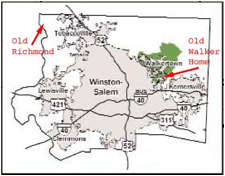 WALKERTOWN
This city is in present day
Forsyth County, an eastern suburb of Winston-Salem, as shown on this map. To
learn more, visit:
http://www.walkertownareahistoricalsociety.org/
This city did not exist in
the time of Robert Walker Esq., but it is in the area where he lived prior to
his move to Richmond. (It's about 17 miles as the crow flies from modern
Walkertown to the site of old Richmond.)
And it is clear that the
city's name derives from the family of our Robert Walker Esquire –
although it is unclear whether it was named specifically in honor of Robert
Esq, or in honor of one of his descendants. I think it most likely that it was
named while a descendant lived there, but in honor of the family as a whole.
Wikipedia gives a reference:
"Walkertown was named for Dr. Robert Walker who was living at the site by
1771." Reference: Powell, William S. The North Carolina Gazetteer: A
Dictionary of Tar Heel Places, Chapel Hill, NC: The University of North
Carolina Press, 1968.
On examination, I conclude
this is a problematic statement. The Robert Walker who lived in the area in
1771 was our "Esquire" and not a doctor, and they may be mixing him
up with somebody else named Robert, and/or a physician named Dr. Walker? Oh,
and we can do better than the "1771". Documents discussed earlier
show he was in the area by 1768 when he got a Tavern license!
The "Walkertown Area
Plan" found at the city web page is more cautious. It says: "The
early history of Walkertown is not clear. However, it is known that Robert
Walker owned a tract of land in the vicinity of present-day Walkertown as early
as 1771." The same plan, in their section on "Identified Historical
Resources" mentions a "Dr. Robert Walker House (D)" built circa
1820, in the central part of the city. (The "(D)" indicates it has
been demolished!)
I made an effort to locate
the Robert Walker Esq property in the Walkertown vicinity using old documents.
I conclude it is in the southern third of the present day Walkertown city
limits – that would make it about 2 miles south of the town center. You
can read my analysis at http://www.coffey.ws/FamilyTree/FamilyNotes/RobertWalkerHouse.htm
Randy Walker says "The
'Doctor' Robert Walker in reference was a Dr. William Robert Walker who was
born 19 Oct 1804 and was the great-grandson of Robert Esq. Dr. Walker came by
way of William Walker, son of Robert Esq. He moved to Missouri in the spring of
1852 where he practiced medicine for over 40 years. On the 10 Feb 1881 he was
supervising the loading of some saw logs and sustained an injury that resulted
in his death 2 days later. He was a pioneer physician in Missouri.”
My own investigation showed
that this "Dr. William Robert Walker" is the one that married
Elizabeth B. Vanhoy, and he was the son of the Robert Walker who married Martha
Love. And he had a brother "Robert Love Walker". However I don't
think he ever went by the name "Robert" – I suspect his brother
used that. He was a physician, and is found, using only the name
"William" and age 45, in the 1850 census in Forsyth County with his
wife and 9 children. He is believed to have become the postmaster when the
Walkertown Post Office was started, according to postal records, on 6/15/1848.
While he might have chosen the name "Walkertown" after himself, it
may have also been informally called that much earlier. He is also found in the
1860 and 1870 census for Henry County, MO, always under the name
"William".
He also doesn't fit with the
Walkertown Area Plan reference to the "Dr. Robert Walker House built circa
1820" – he would have been age 15 and much too young to build a
house. Although he might have later practiced medicine from that house. (I
wonder if his FATHER could have been the "Dr. Robert"?)
MY PERSONAL ASSESSMENT (BY
FRED COFFEY) This all started with Robert Walker Esq., of Surry County,
who lived in the area of Walkertown by no later than 1768-1771, and who had an
obsession about assuring there would be an abundance of "Roberts" among his descendants. He
had a son William, who in turn dutifully named a son Robert (1770–1848), assuring both William and Robert recognition in Robert Esq's will. William's son Robert married Martha Love, and became
a very wealthy and prominent citizen, and probably built a big house about 1820
in the area near Love's Methodist church (now central Walkertown). And, being
grateful to grandfather Robert, he
named his own sons "William Robert"
and "Robert Love". And son
William Robert (always called
William in the census and his father's will) practiced medicine and served as
postmaster, in an area that was becoming more commercial and that people began
to call "Walkertown".
Then along come the
historians, who learn that there had been Walkers about, using the name Robert, since 1771, that one of the
Roberts lived in a big house, and that one Walker was a physician/postmaster
when the area began to be called "Walkertown". Hey, that's all you need to start talking
about "Dr. Robert Walker who
lived here since 1771 and built an historic house in about 1820"!
Being a descendant of Robert
Walker Esquire, my view is that it all comes back to this Walker family
patriarch! So "Walkertown", indeed honors my ancestor!
LAND HOLDINGS AND TRANSACTIONS, WALKERTOWN AREA:
Robert Walker was on the
Rowan County 1768 tax list of Jacob Laesch. This list is for Bellows Creek (aka
Belews Creek). Parts of the Walkertown area drain into Belews Creek, so this
tax list is probably referencing his land in and near today's Walkertown. So he
was there by no later than 1768. Also note earlier discussion under “DNA”,
which suggests strongly that Robert and his brother David were still in
Pennsylvania in 1765. I believe that while he may have been on this tax list,
he did not yet officially OWN this land:
The northern part of North
Carolina was in the Granville Proprietary. The Granville agents were making
land grants from 1744 to 1763. When Lord Granville died in England in 1763, his
land offices closed and never reopened. In 1778 North Carolina opened land
offices, and began issuing land grants. But between 1763 and 1778 you either
bought land from someone who had a Granville Grant, or you worked on the basis
of "Squatters Rights". There's a passing reference to Robert in the
Moravian 3 July 1771 Bethabara Diary, mentioning "…he is not a
Freeholder". I think that suggests he was a "squatter" without
legal title to the land where he lived.
It appears that in 1778, as
soon as North Carolina opened land offices, Robert applied for the land he had
been squatting on. And he apparently got
it. In the Surry County, NC, Deed Book C,
Robert Walker received four land grants on 3 Nov 1784. And others in his
family were also aggressively acquiring land in the vicinity of “Muddy” and
“Belews” creek. Here are the relevant grants:
|
Name |
County |
Year Entered |
Year Issued |
Acres |
File # |
Location |
|
Robert Walker |
Surry |
1779 |
1784 |
150 |
588 |
On a branch of Blews creek [Blues Creek] |
|
Robert Walker |
Surry |
1778 |
1784 |
500 |
652 |
O the Middle Fork of Muddy Creek |
|
Robert Walker |
Surry |
1779 |
1784 |
300 |
727 |
On the waters of Muddy Creek |
|
Robert Walker |
Surry |
1779 |
1784 |
500 |
791 |
On the head of Blues Creek |
|
David Walker (a minor) |
Surry |
1778 |
1780 |
300 |
234 |
On the waters of Muddy Creek |
|
Robert Walker Jr. |
Surry |
1779 |
1780 |
600 |
291 |
Beg. At the Morvarian Corner white oak |
|
William Walker |
Surry |
1780 |
1784 |
100 |
726 |
On the waters of Mudy (Muddy) Creek |
|
John Walker |
Surry |
1778 |
1780 |
500 |
317 |
Beg. At a black oak on the North side of a branch |
That’s 2950 total acres, or
4.6 square miles! Looking at a map, my impression is that ALL of modern
Walkertown is only about 20 square miles! Note that two of the four grants to
Robert are on Muddy Creek, and two on Blues/Blews/Belews Creek. His holdings
crossed the watershed, which is roughly in the middle of Walkertown.
Another Walker researcher,
Betty Hicks, found the 1778 entry that became File #652 above, in “Abstracts of
the Land Entries, 1778-1781, in Surry County, NC” reporting “#164
ROBERT WALKER enters 500 acres of land in Surry Co. lying on the MIDDLE FORK of
MUDDY CREEK, beginning at the WACHOVIA line at a point due W from a big poplar
tree on the creek with a big notch in it being a determined line betwixt JOSEPH EDWARDS A FORMER PROSSESSOR and I, so
running S some distance over the road that leads to the iron works so W to a
corner settled betwixt MY BROTHER DAVID,
DEC'D., so running NW a conditional line to the WACHOVIA Line - June 9
1778. (Warrant Granted. December 28, 1778 - entry withdrew, money
refunded.)”
(NOTE: In this, I think
“PROSSESSOR” should read “PROCESSIONER”, referring to the practice of a
“procession” of land owners routinely walking the boundaries of land, verifying
and updating markers as appropriate (e.g., is the “big poplar tree” still
there)? These New Englanders drew on the age-old ritual of beating the bounds,
also called hunting the borough, processioning, or perambulation. Also the
“iron works” mentioned were located very near what is now Reidsville, NC. The
road to the iron works would approximate the modern Reidsville Road (Hwy 158)
in Walkertown. This highway intersects “Iron Works Road” just west of
Reidsville.)
One of the particularly
interesting grants was found by Kathy Walker: State of North Carolina Grant No.
233 (this would be File #234 above) Issued 3 Apr 1780 Entered 21 Aug 1778. “Know ye that we have granted to David
Walker /a minor/ three hundred acres of land in Surry County on the waters of
Muddy Creek beginning at a Black Oak running North West being a line agreed on with Robert Walker
fifty five Chain to a Post Oak thence West Ten Chain to a Stake in the Moravian
Line thence on Said line South Seventy eight Chains to Daniel Huffs Corner Post
Oak thence East on Huffs line forty four Chains to a Hicory on the Same hence
North to the Beginning. TO HOLD unto the Said David Walker /a minor/ his Heirs
and Afsigns forever. Dated the Third Day of April 1780. By His Excellency’s
Com’d R. C. Carnell J. C. Hargan Sec.”
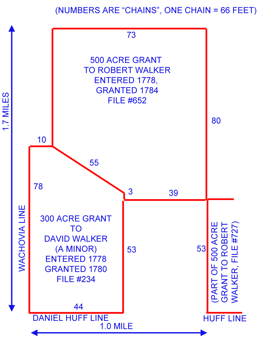
There is a complementary
Grant by North Carolina Issued 3 Nov 1784 to Robert Walker: “No 651: Know ye that we have granted unto Robert
Walker five hundred acres of Land in Surry County on the Middle Fork of Muddy
Creek beginning at a post oak runs thence East seventy three chains to a stake
South eighty chains to a stake West thirty nine Chains to a black oak in David Walkers line north on his line
three chains to a black oak North West on his line fifty five chains to a post
oak then north to the beginning to hold unto the said Robert Walker his heirs
and assigns forever dated the Third day of November 1784.
These two grants together
are clearly for the land settled by Robert and by his brother David. Brother
David is deceased, and that land went to David Junior, a minor. (Oh, and I
strongly suspect that the “Daniel Huff” mentioned was also my ancestor, that he
was the grandfather of Mary Jones who married Robert Walker Jr.!?)
There is a third grant of
interest, File #727 above. I had trouble reading and following the details, but
it clearly refers to a connection between a corner of one of the above grants,
and to the Daniel Huff line. The above is a sketch of how the three fit
together:
All three of these grants refer to “Muddy
Creek”, which puts them in the south half of Walkertown.
In later years, Robert sold
some parts of his grants. On 14 Feb 1786 he sold two tracts of land on Muddy
Creek and Blews (Belews) Creek, which were presumably part of these grants.
This sale was to Mordecai MENDENHALL,
and was also noted in the Surry Court Minutes on Page 84. There was an
additional sale of another 50 acres on Muddy Creek on 6 Mar 1786 to Archibald
CAMPBELL, also noted in the Court Minutes on Page 90. The sale price was 47£
10s. This one is very clearly part of the 1784 grant, since the deed notes that
it was "part of larger tract granted to Robt. Walker 3 Nov 1784". The
deed also indicates that the sale was by "Robert Walker, Esq. and wife
Mary". Note that Robert's will was
drafted in the same month as this last sale. This may have indicated he was
then in poor health?
LAND HOLDINGS AT RICHMOND:
The earlier map also shows
the location of Richmond. We found a
1774 survey showing the land holdings around Richmond, as follows:
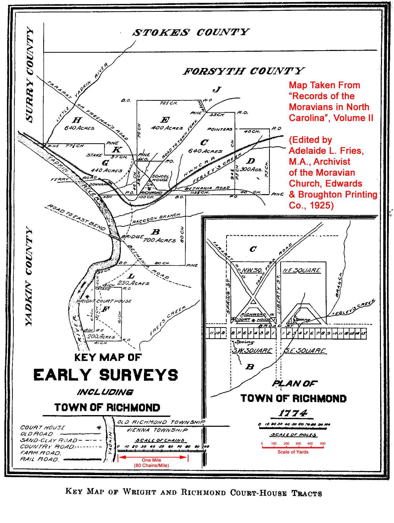
You will see an "Area
E" near the top with 400 acres – that is land owned by Robert Walker
Esq. And he also owned, according to the 1786 tax list, some 12 town lots. (You
can easily find the Richmond site using Google Maps. Just ask for “Payne Road,
Tobaccoville, NC”. It’s a short road, and the site is the cleared area at the
eastern end.)
This image shows a location
identified as "Gideon Wright Home & Courthouse". Before the
Richmond courthouse was built, the county commissioners met in a building on
the farm of Gideon Wright. And there appear to have been some serious political
issues! Following is a quote I borrowed from www.planetmurphy.org :
"On the local level in Surry County, another sort of
war was taking place. The county leaders
– Gideon Wright, Martin Armstrong, Alexander Martin, and Benjamin
Cleveland – started fighting over the location of the new Surry Court
House. This fight became part of the
local issues of the on-coming American Revolution. A patriot group including Martin Armstrong
pushed to have the courthouse at Mulberry Fields (Wilkesboro). Another group pushed to locate it eastward on
the Yadkin River farm of Gideon Wright.
Both Armstrong and Wright took the matter directly to Governor Tryon to
obtain his permission. Wright won and
the courthouse was constructed on his farm which along the East Bend - Bethania
Road. Martin Armstrong and his followers
refused to accept the decision and began efforts to move it to Mulberry
Fields. Even as justices of the peace,
they refused to attend any court session at courthouse on Wright's farm. Several years later in about 1775, the
courthouse suspiciously burned to the ground."
ROBERT WALKER ROLE: The new
courthouse was built at Richmond in about 1779, and Richmond was only about 2
miles northeast of Gideon Wright's farm. So Armstrong never won his battle to
locate it at Wilkesboro (about 40 miles farther west). The Surry Court records
do show that Robert Walker was willing to sit on the Gideon Wright court, so he
could not have been part of the Armstrong faction that refused to attend.
Armstrong DID participate as a Commissioner after the move to Richmond, so that
may have been the final compromise? Armstrong, Wright and Walker all became
major land owners around Richmond.
I will talk more about
Robert's associations with Wright and Armstrong in a moment.
There are some Richmond land
records I'm still puzzling over, but I'm beginning to suspect that Armstrong,
Wright, and maybe Walker, were getting grants in the Richmond area from North
Carolina in 1778. Note that 1778 is when NC began to make its own grants from
areas of the former Granville Proprietary. There are also references to old
Granville grants below. I found the following references to grants in the
Richmond area, with boundaries related to Armstrong/Wright/Walker lands. There
is an implication that Robert’s land was formerly owned by a “Douglass”,
suggesting that Robert acquired his land from a man who received a Granville
grant?
JOSEPH WINSTON HIS ENTRY BOOK, SURRY CO NC, LAND ENTRIES;
1778-1781 by Agnes M. Wells, Virginia G. Phillips, Carol J. Leonard; 1987
p.45/497 George Sprinkle entered 360 acres in Surry Co,
North side of the Yadkin below Gidion Ritts [Wrights], it being an old entry
made in Earl of Graville's office. (SEE NOTE 1 BELOW) 12 Aug 1788.
p.50/550 Gidion Wright entered 200 acres in Surry on the
Yadkin R, beg at upper corner of George Springles, thence NE up the river and
round to my old line. 13 Aug 1778.
SURRY CO NC DEEDS; Vol 1 DB A; 1770-1783; Mrs. W. O. Absher,
Mrs. Robert K Hayes
p.229-30 10 Dec 1778 NC Grant #18 to John Armstrong. 640
acres both sides Fralesy Crk [Frays, Freys, Freese Crk?] including the town of
Richmond. On Gideon Wright's line crossing Tarrarat Road, Townfork Rd, the
agreed line bet Armstrong & Robert
Walker.
p.243-244 10 Dec 1778 NC Grant to Samuel Cummins. 640 acres
Yadkin R adj Gideon Wrights line, below mouth of the Little Yakin crossing
Tarrarat Rd to Great Yadkin.
SURRY CO NC DEEDS; Vol 1 DB B; 1770-1783; Mrs. W. O. Absher,
Mrs. Robert K Hayes
p.84 3 Apr 1780 NC Grant to Gideon Wright. 200 acres Yadkin
R, his own line
p.138 1 Aug 1781 Samuel Cummins to Joseph Phillips. 640
acres on Yadkin adj Gideon Wright line, below mouth of the little Yadkin,
crossing Tararat [Ararat] Rd. [This 640 acres was a NC grant to Saml Cummins on
10 Dec 1778]
p.185 11 Sep 1781 Joseph Phillips sold the above 640 acres
to William Shepperd. Adj Gideon Wright's line, below mouth of the Little
Yadkin, crossing Tararat Rd & the Little Yadkin to Great Yadkin.
SURRY COUNTY LAND ABSTRACTS: 29 Apr 1778 ARMSTRONG, JOHN 640 acres on Figley's Creek
bounded by: Gideon Wright "land
formerly belonging to John Sneed" caveat filed by Robert Walker - new survey ordered
SURRY COUNTY LAND ABSTRACTS: 29 Apr 1778 ARMSTRONG, JOHN 640 acres on Figley's Creek
bounded by: bounded by: town of Richmond caveat filed by Robert Walker - new survey ordered
SURRY COUNTY LAND ABSTRACTS: 29 Apr 1778 WALKER,
ROBERT Senr. 400 acres formerly known by the name of Douglass place
bounded by: Gideon Wrights old survey, near Freeman’s Road “being a line
determined by John Armstrong and myself” to the forks of the road that leads to
Dan River
NOTE 1: A Gideon Wright
genealogist, Kay Haden, reports: "The Grant from the Earl of Granville to
Gideon Wright was made 10 Aug 1762; Gideon Wright was said to be of Rowan
County. The tract was on the East side of the Yadkin R opposite to Benjamin
Pettit, 69 acres. This was a lease for 3h for every hundred acres to be paid at
the Court-house of Rowan - a typical grant from the crown in this time period.
Surveyed 19 May 1762. Gideon Wright & George Sprinkle Surveyor & Chain
Carriers. Proved in open Court at Rowan Co, Oct 1762 and Recorded in Book 5,
p.75."
There's another tiny land
transaction for a tiny town lot in Richmond that is quite interesting from an
historical perspective:
SURRY CO NC DEEDS; VOL 1 DB B; 1770-1783; Abstracted by Mrs
W. O. Absher, Mrs. Robert K Hayes p. 297-298: "6 Feb 1783 Samuel Cummins
& wife Mary to Robert Walker for
20 shillings. 7 1/2 square poles in Town of Richmond, corner Diamond bet sd Cummins & Walker,
NW Square of town, corner Broad St, lot formerly claimed by Gideon Wright. Wit:
Martin & John Armstrong."
BACKGROUND: This is an
interesting wrap-up of some American Revolution events: Colonel Gideon Wright
supported the King in the American Revolution and his lands were confiscated
(but his wife was allowed to continue using them). Robert's close friends,
Colonel Martin Armstrong and his brother John, were winning leaders on the
Patriot side. Gideon died in 1782.
Armstrong and Walker are both now sitting on the Surry Court (and actually
approving matters related to Gideon's estate). And Walker is buying a piece of
Gideon's former holdings. The victors divide the spoils?
ROBERT WALKER'S ASSOCIATES:
Let me introduce a group,
and two individuals, who were clearly close associates of Robert, and who played
prominent roles in the history of our country. Their interactions with Robert
will help understand Robert:
The Moravians:
The Moravians were a
Protestant Church originally from Pennsylvania, who expanded into a major
settlement in North Carolina. Robert usually had good rapport with the Moravian
community – before moving to Richmond his property was just outside the
Moravian block, to the East. And the Moravians kept great diaries, with many
references to Robert. It's interesting reading – see a whole separate
paper I wrote on his Moravian relationships above.
Martin Armstrong:
Who is this person? I
believe he was a major presence in the life of Robert Walker Esq., and probably
a very close friend. His acquaintance with Robert dates at least from the
formation of Surry County in about 1770 and, at Robert's death in 1786, Martin
was one of the Executors of Robert's last will and testament (along with
Robert's wife Mary and son Robert Jr.).
We first find Martin as a
surveyor laying out the Surry County line, with its reference to passing
Robert's house. We find Martin serving as County Sheriff when Robert first
appears as a Justice on the Surry Court. The Surry County courthouse was built
on land owned by Martin, and our Robert acquired several town lots in Richmond.
Martin also served alongside Robert as a fellow Justice for many years, until
Robert's death. Martin was Colonel of the Surry Militia during the revolution,
and probably commanded Robert's son Robert Jr. at the Battle of Kings Mountain.
Of particular interest may
be that Martin Armstrong was a MAJOR land speculator at the time our Robert got
involved in Tennessee land speculation. Martin and his brother John Armstrong
played major roles in the scandals involving Tennessee land, where the two
brothers were in charge of taking entries to claim land. Martin at one time
held 50 land patents and 260,000 acres for himself.
And, in my mind, there is
little doubt that Robert Walker's own land speculation benefited from his close
association with Martin Armstrong. Again, this is an extremely complicated
subject, and one that could stand further research into the roles and holdings
of Robert Walker.
John Armstrong:
Brother of Martin, see
above. John managed the land office in
Hillsborough, NC, after the revolution. His "Entry Book" records
several warrants initiating the granting of land around the Tennessee River to
Robert Walker and his family. He also signed as a witness to the proving of
Robert's will.
Gideon Wright;
Gideon, and our Robert, also
had a long relationship. They appear together as Justices from the earliest
days after the formation of Surry County.
Ultimately, Gideon Wright
and Martin Armstrong came down on opposite sides of the American Revolution.
Gideon and his brother Hezekiah remained loyal to the King, and were both
Colonels in the Whig militia. Martin, and his brother were officers on the
Patriot side.
FIRST SPOUSE: ANNE?
(See the discussion earlier
about whether or not “Ann” was the name of Robert’s first wife.
SECOND SPOUSE: MARY
We do not yet have any firm
information as to family origins of either of Robert’s wives. However there may
be a clue regarding the second wife: There is a marriage record extracted from
the Family History Library, County Records, Salt Lake City, UT, dated 18 Aug
1775, showing that a Mary PROWELL married a Robert Walker in Guilford County,
NC. Guilford is the next county to the East of Surry County. However we have
been using this date of 18 Aug 1775 as the date that Robert Walker JUNIOR married
Mary JONES, and that Mary was from Guilford County, so there's clearly (!) some
confusion here! (I think that marriage date for Robert Jr. is less likely,
because it would mean that Robert Jr. and Mary had no children for the first 5
years of their marriage. Also Mary Jones would have been only age 13 if they
married in 1775.)
Will try to do some future
checking, but this is difficult. All we know that Robert Sr. and Robert Jr.
each married a wife named "Mary" at more or less the same time.
We do know MORE about Mary AFTER
Robert Esq’s death. Kathy Walker discovered Surry Court documents regarding
guardianship of the two young girls and marriage records, it is now evident
that Robert's widow Mary remarried Jesse Lester on 20 May 1787. Picking up from Kathy’s info, I wrote about
Mary (Walker) Lester as follows:
www.coffey.ws/familytree/familynotes/MaryWifeOfRobert.pdf
MY FAMILY LINE, ROBERT’S DESCENDANTS:
Everything I presently know
about Robert Walker Esq is above. However his son Robert (Junior) may be of
interest to some. Have a look at the following:
http://www.coffey.ws/FamilyTree/Docs/WALKERRobertJr(W).pdf
And my initial
"search" for my Walker roots is discussed with his grandson, William,
at:
http://www.coffey.ws/FamilyTree/Docs/WALKERWilliam(W).pdf
Please report corrections or
additions to... Fred Coffey, 508-573-1372
FredCoffey@AOL.COM